Honest Guide · From the Tao Spa Team
Massage for Migraines
Massage for migraines is one of the most searched — and most oversold — promises in spa wellness, so here is the honest version up front. Migraine is a neurological condition that medicine treats; massage is a relaxation practice whose real strengths sit next door, against stress and the neck-and-shoulder tension of tension-type headache. This guide sorts the two apart, lays out what research actually supports, and flags the symptoms that should send you to a doctor rather than a spa. The related bookable session at Tao Spa runs 60 minutes at both Pennsylvania locations.
The distinction that decides everything
Migraine vs tension-type headache
| Trait | Migraine | Tension-type headache |
|---|---|---|
| Where it hurts | Usually one side of the head | Both sides — a band of pressure |
| Pain quality | Throbbing, pulsing | Steady, squeezing pressure |
| Typical length | 4 to 72 hours untreated | 30 minutes to 7 days |
| Other symptoms | Nausea, aura, light + sound sensitivity | Light or sound sensitivity, not both |
| Everyday movement | Makes it worse | Does not make it worse |
| Where massage fits | Between attacks, gently, doctor-led plan | Directly on the stress-tension pattern |
Summarized from NINDS and Mayo Clinic patient materials linked below. Many people have both patterns at different times — a doctor sorts out which is which.
I · Two different problems
Why the label matters before the massage
The NINDS headache overview sorts primary headache into distinct conditions, and the two everyone mixes up could hardly be more different. Migraine brings throbbing pain on one side, often with nausea and sensitivity to light and sound, in attacks that run 4 to 72 hours; researchers point at brainstem changes, the trigeminal nerve, and chemical messengers like serotonin and CGRP. It is neurology, not tight muscles.
Tension-type headache — the most common headache there is — reads differently: steady pressure on both sides, 30 minutes to 7 days, no aura, no vomiting, and it does not worsen when you climb the stairs. Its research story names genes, brain signals, and muscle tenderness, with emotional stress and strained head-and-neck posture among the recognized triggers. One of these two problems has a large muscular component a massage table can reach. The other does not — and every honest claim on this page flows from keeping that straight.
II · The evidence
What research actually supports
For migraine itself, the effective tools in the literature are medical: over-the-counter pain relievers, triptans for attacks, and preventive prescriptions a neurologist chooses. Where does bodywork appear? In a supporting sentence — NINDS notes a doctor can recommend adding physical therapy, massage, and gentle exercise into a treatment plan, alongside biofeedback, relaxation training, and cognitive-behavioral approaches for the stress load. A complement inside someone else's plan: that is massage's documented slot, and it is the only one we claim.
The adjacent evidence is worth knowing because it maps the honest ceiling. NCCIH reports that acupuncture — a far more studied hands-on practice — may reduce the frequency of tension headaches and help prevent migraines, findings hedged by trials where sham treatment performed just as well. If that is the strongest hands-on evidence available, a spa promising to fix migraines with massage is writing checks the research cannot cash. What a great session reliably delivers is narrower and still valuable: an hour of genuine downshift, looser neck and shoulder tissue, and one fewer week of accumulated bracing.
"Massage's documented role is a complement inside a doctor's plan — and a spa that claims more than that is selling past the evidence."
III · The mechanism
Where massage plausibly earns its hour
Cross-reference the trigger lists and a pattern appears. Mayo Clinic's migraine page lists stress at work or home as a trigger and neck stiffness among the prodrome warning signs 1 to 2 days before an attack. The tension-type literature names emotional stress and head-straining posture directly. Stress and neck tension sit on both lists — and those two are squarely what an hour of skilled bodywork addresses.
So a well-designed headache-focused session does not chase the migraine; it works the shared territory. The suboccipitals at the base of the skull, the upper traps, the scalp, the jaw — the specific geography where screen posture and clenching store the week. Both of our locations run this as a dedicated 60-minute session: the Migraine Massage in Glenside, open 7 days, and the Migraine Massage in Spring House, whose page details how we strip light, scent, and sound triggers out of the room itself.
IV · Red flags
When massage is the wrong move
Some headaches are emergencies wearing a familiar costume, and clinical guidance is unambiguous about the warning signs. Get medical care right away — not a massage — for any of the following:
- A sudden, severe "thunderclap" headache, possibly with a stiff neck
- Headache with fever, confusion, seizures, double vision, weakness, or trouble speaking
- Any headache after a head injury
- A first or worst-ever headache, or new headache pain after age 50
- A pattern that changes, worsens over days, or strikes 2 or more times a week
There is a quieter trap worth naming too: medication overuse headache, where taking pain relievers more than 14 days a month — or triptans more than 9 — starts causing the very headaches being treated. If that loop sounds familiar, the fix is a doctor's plan, and no amount of bodywork substitutes for it. Massage belongs in the calm weeks this section is designed to protect.
V · The practical version
If you want to try massage for migraines
Book gentle and targeted, not deep and general: a 60-minute head, neck, and shoulder session at light-to-medium pressure, timed for the stretch between attacks, in a room set up for your triggers — dim, scent-free, and quiet on request at both of our locations. Tell the therapist you are headache-prone before the hour starts, and say so again the moment any pressure feels wrong. A licensed, cross-trained therapist will adjust without being asked twice.
Then surround the hour with the unglamorous basics the clinical self-care lists actually emphasize: consistent sleep, steady hydration, regular meals, and a headache journal noting timing, triggers, sleep, and what helped — the same record that makes your next doctor's appointment dramatically more useful. Guests who keep the routine tend to settle at a visit every 2 to 4 weeks. And if part of what you carry is upper-back bracing, the journal will tell you — that is the visit to pair with a 15-minute cupping add-on after the neck work is done.
What a headache-focused session looks like
Gentle, specific, above the shoulder blades — the working territory shared by stress tension and prodrome-week stiffness.
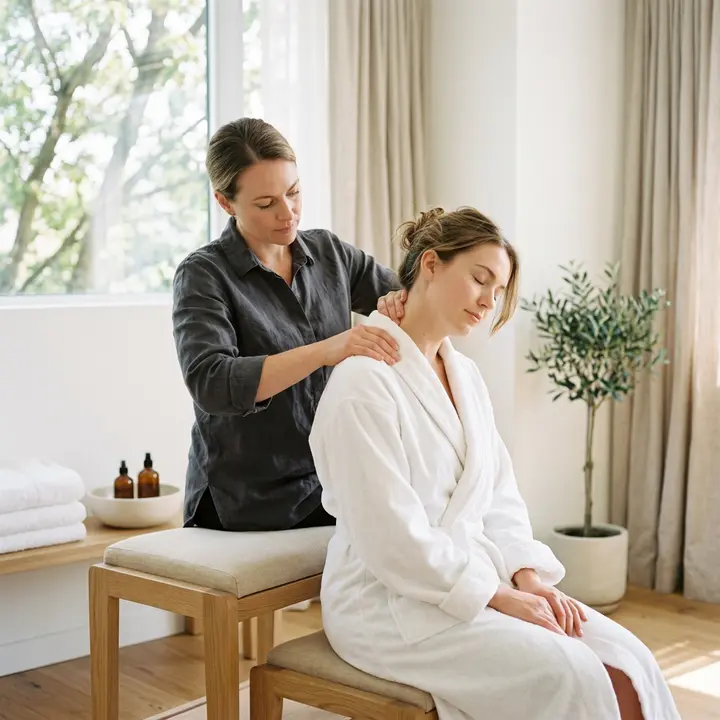
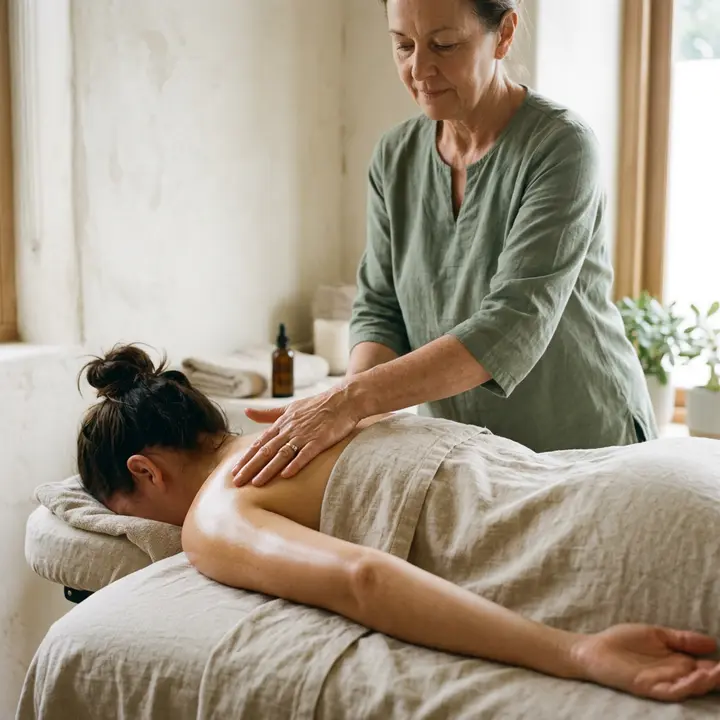
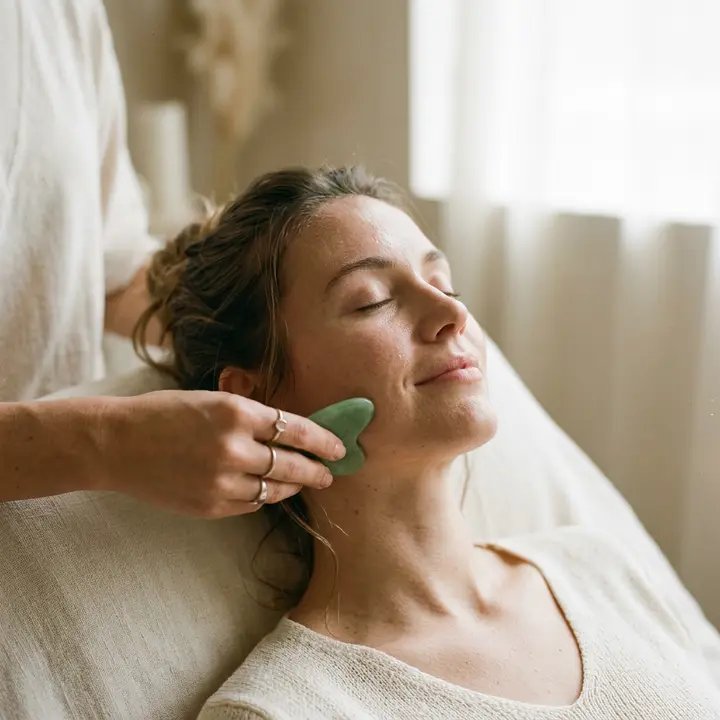
Treatment photography is illustrative of the services described.
Key facts
Where to book: Tao Spa at a glance
| Address | 106 N Keswick Ave, Glenside, PA 19038 |
|---|---|
| Phone | (215) 824-8585 |
| Hours | Mon–Sun 9:00 AM – 9:00 PM |
| Google rating | 4.7 stars from 359 reviews |
| Session lengths | 15 · 25 · 30 · 50 · 60 · 75 · 90 · 100 · 120 · 360 minutes |
| Menu size | 45 bookable services across 8 categories |
| Other location | Tao Spa Spring House — 752 N Bethlehem Pike, Spring House, PA 19477 |
| Other location hours | Mon–Sun 10:00 AM – 9:00 PM (Closed Tuesday) |
Session lengths
Headache-adjacent sessions on the menu
| Service | Length | Menu section |
|---|---|---|
| Reflexology Special | 50min | Tao's Specials |
| Migraine Massage + Free Guasha | 60min | Massage Pro |
| Couples Reflexology | 60min | Couples & Four Hands |
| Reflexology | 30min | Reflexology & Foot |
| Scalp Hands & Feet Massage | 15min | Specialty Massage |
| Cupping | 15min | Specialty Massage |
| Gua Sha | 15min | Specialty Massage |
The 60-minute Migraine Massage is offered at both locations; Spring House closes Tuesdays.
Frequently Asked Questions
Does massage help migraines?
Honestly: massage is not a migraine treatment, and no reputable spa should sell it as one. What research bodies describe is a supporting role — doctors may add massage, physical therapy, and gentle exercise around a medical plan, and massage has its clearest value against the stress and neck-shoulder tension that many people with migraines carry between attacks.
Can massage stop a migraine that has already started?
No, and trying usually backfires. During an attack, most people are sensitive to touch, light, sound, and movement — a session means a car ride, a face cradle, and stimulation your nervous system is begging to avoid. Rest in a dark, quiet room and book the massage for the week between attacks instead.
Does massage help tension headaches?
This is where bodywork is on firmer ground. Tension-type headache is the most common headache, its named triggers include emotional stress and strained neck posture, and clinical self-care lists include warmth and temple massage. A focused 60-minute head, neck, and shoulder session works directly on that pattern.
Can a massage trigger a migraine?
It can, through the side doors: strong scented oils, bright rooms, chatty environments, or aggressive deep neck work are all recognizable trigger shapes. That is why our migraine-focused sessions run low-lit, optionally scent-free and silent, at light-to-medium pressure. Tell your therapist your triggers before the hour starts.
What kind of massage is best for migraine-prone people?
Gentle and targeted beats deep and general. A 60-minute session focused on the suboccipitals, upper traps, scalp, and jaw addresses where stress tension actually sits — at pressure your head can tolerate. Save heavy full-body deep tissue for headache-free stretches, and keep the two bookings separate.
How often should I book massage for headache-pattern tension?
Guests using it as regular maintenance settle around every 2 to 4 weeks, with a weekly visit during high-stress stretches. Pair it with the basics that clinical guidance actually emphasizes — consistent sleep, hydration, regular meals, and a headache journal — and massage becomes one steady piece of a larger routine.
When should I see a doctor instead of booking a massage?
Immediately, if a headache is sudden and severe, follows a head injury, or arrives with fever, stiff neck, confusion, weakness, vision loss, or trouble speaking. Also see a doctor for headaches that are new after age 50, changing in pattern, or striking 2 or more times a week. Massage is for the calm in between — never a substitute for diagnosis.
Ready to Relax at Tao Spa?
Whether you're planning a self-care day, booking a massage, or exploring facial treatments, Tao Spa offers a relaxing spa experience at two convenient Pennsylvania locations.
Tao Spa
Glenside: 106 N Keswick Ave, Glenside, PA 19038
Spring House: 752 N Bethlehem Pike, Spring House, PA 19477
(215) 824-8585 Text UsPlan your visit
How do I book a massage at Tao Spa?
Book a massage at Tao Spa in 4 steps: pick Glenside or Spring House, choose a 30, 60, 90 or 120-minute session, reserve online or call (215) 824-8585, then arrive 10 minutes early. Walk-ins are welcome at both Pennsylvania locations whenever a therapist is free, and gift cards are valid at either address.
- Choose your location. Glenside is at 106 N Keswick Ave, Glenside, PA 19038, open Mon–Sun 9:00 AM – 9:00 PM. Spring House is at 752 N Bethlehem Pike, Spring House, PA 19477, open Mon–Sun 10:00 AM – 9:00 PM (Closed Tuesday).
- Pick a treatment and a session length. Massage, reflexology and facials run 30, 60, 90 or 120 minutes; couples rooms are booked in 60, 75 or 90-minute blocks. Not sure what you need? Our full service menu lists every treatment with its length.
- Reserve online, call or text (215) 824-8585. Weekend evenings and couples rooms fill first, so book 2 to 3 days ahead for those slots. Walk-ins are taken any time a therapist is open.
- Arrive 10 minutes early. A first visit starts with a short intake about pressure preference, problem areas and any health notes. Gift cards never expire and work at both locations.